Shopping Cart (0)
Close


Choosing the right food for your cat can feel confusing. There are many formulas, flavours, and food types, and each cat has different nutritional needs. Your cat’s age, activity level, and health needs can all affect the type of food that suits them.
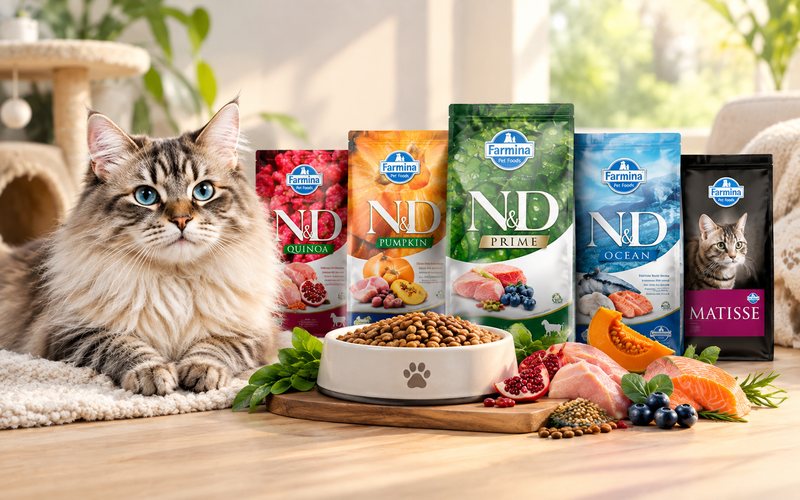
Farmina offers several feline nutrition ranges, including N&D Prime, N&D Quinoa, N&D Pumpkin, N&D Ocean, and Matisse. Some formulas are made for everyday feeding, while others focus on needs such as digestion, weight management, skin and coat care, or urinary support.
In this guide, we’ll look at N&D cat food, Matisse cat food, life-stage formulas, functional diets, and important ingredients to check before making a choice. We’ll also cover simple feeding and buying tips to help you find a formula that fits your cat’s needs.
Choosing between different food lines becomes easier when you understand what each range is designed to offer. Instead of picking a recipe only by its flavour, look at the protein source, recipe type, and the main purpose of the food. This gives you a clearer way to compare your options.
The N&D range covers several recipe styles. N&D Prime focuses on animal-based nutrition, while N&D Quinoa offers functional recipes for needs such as digestion, skin and coat care, weight management, and urinary support. N&D Pumpkin includes pumpkin in its recipes, while N&D Ocean uses seafood proteins. N&D Ancestral Grain uses selected ancient grains, and N&D Tropical Selection adds another option within the N&D family. You can explore available Farmina Cat Food options from trusted pet stores.
Matisse cat food is another range, with everyday recipes for different stages and needs. Its current selection includes kitten, adult, and neutered formulas, along with dry and wet options.
Farmina Vet Life is different from regular daily food. It includes specialised diets made for specific health needs, such as renal, gastrointestinal, urinary, and weight management support. These diets are best chosen with veterinary guidance when a cat has a diagnosed health problem.
The ingredient list is a useful place to start when comparing recipes. Look for clearly named animal protein sources, such as chicken, lamb, or fish. Then check the sources of fat, fibre, and carbohydrates.
Don’t judge a recipe by one ingredient alone. The complete formula matters. Protein levels, fat, fibre, calories, and other nutrients all work together to provide the overall diet.
Some N&D recipes are made without cereals, while N&D Ancestral Grain includes selected ancient grains such as spelt and oats. This gives cat owners different recipe styles to consider.
Grain-free food isn’t automatically the right choice for every cat. It’s more useful to look at the full recipe and consider your cat’s individual dietary needs.
| Range | Main Focus | Formula Style |
| N&D | Daily and functional nutrition | Grain-free and grain-inclusive options |
| Matisse | Everyday feline nutrition | Dry and wet formulas |
| Vet Life | Specific dietary needs | Specialised veterinary diets |

Cats don’t all need the same type of food. A growing kitten needs nutrition for healthy development, while an adult cat needs a balanced diet for daily maintenance. Neutered cats may also need closer control of their energy intake. Other needs, such as sensitive digestion, skin and coat support, or weight control, can also affect food choice.
Farmina offers feline formulas for different life stages and specific nutritional needs. The right choice should match your cat’s age, activity level, body condition, and any health concerns.
Kittens grow quickly, so their food needs to support healthy growth and development. A kitten formula should provide the nutrients needed for growing muscles, bones, and body tissues.
Choose food that is clearly labelled for kittens rather than using an adult recipe. Farmina currently lists kitten formulas in its feline range, including recipes made for kittens from 1 to 12 months.
Follow the feeding guide on the pack and divide the daily amount into suitable meals. As your kitten grows, its food needs can change, so keep checking its body condition and adjust portions when needed.
Adult cats need food that supports normal body function without giving them more energy than they use. An adult maintenance diet should suit your cat’s size, activity level, and lifestyle.
An indoor cat that spends much of the day resting may need less food than an active cat. Measuring each serving can help prevent overfeeding. It’s also useful to monitor your cat’s body shape and weight instead of judging portions by appetite alone.
Farmina’s current feline range includes adult recipes across several food lines, giving owners options for different dietary needs.
Neutering can change a cat’s energy needs and may increase the need for careful weight control. A neutered cat formula can be useful when your cat needs controlled energy intake.
Farmina offers specific recipes for adult neutered cats. Its N&D Quinoa Neutered formula, for example, has reduced calories and added fibre, along with a high protein content.
The formula is only one part of weight control. Portion size matters too. Measure the daily serving and adjust it when needed based on your cat’s body condition and activity level.
Some cats have more sensitive digestive systems than others. A digestive support formula may be suitable when you’re looking for food designed around specific digestive needs.
Farmina lists a Digestion formula for adult cats, with a recipe designed to support digestibility.
If your cat has repeated vomiting, diarrhoea, poor appetite, or sudden changes in stool, don’t keep changing its food without finding the cause. A vet can help decide whether a specialised diet is needed.
Healthy skin and a good coat start with complete nutrition. Protein provides important nutrients for body tissues, while healthy fats and fatty acids can support normal skin and coat condition.
A skin and coat formula may be useful when this is a specific nutritional goal. Farmina lists skin and coat recipes within its feline range, including formulas with omega 3 fatty acids.
Food can support normal skin and coat health, but signs such as heavy shedding, bald patches, redness, or constant scratching can have other causes. These changes should be checked by a vet.
Weight management is mainly about matching your cat’s food intake with its daily energy needs. A weight management formula can help with controlled calorie intake, but portion size still plays an important role. Farmina lists weight management formulas designed to support a healthy body weight.
Urinary nutrition has a different purpose. Urinary support formulas are made around specific nutritional needs and aren’t necessary for every cat. Farmina lists urinary formulas designed to support urinary tract needs.
If your cat has a diagnosed urinary problem, choose a specialised diet with veterinary advice. The right food depends on the cat and the condition being managed.
For example, an indoor Persian cat may spend much of its day resting, while an active outdoor cat may use more energy. Their daily food needs may therefore be different, even when both cats are healthy.
| Cat Type or Need | Formula Focus | Key Consideration |
| Kitten | Growth formula | Life stage nutrition |
| Adult cat | Adult formula | Daily maintenance |
| Neutered cat | Neutered formula | Energy intake |
| Sensitive digestion | Digestive support formula | Digestibility |
| Skin and coat | Skin and coat formula | Fatty acids and nutrition |
| Weight management | Weight focused formula | Calories and portions |
| Urinary support | Urinary focused formula | Individual nutritional needs |
The N&D range includes several recipe styles, and each one has a different purpose. Instead of choosing by the name alone, look at the main ingredients, recipe style, and nutritional focus. This makes it easier to find an option that fits your cat.
Farmina N&D Prime cat food is a grain free range built around animal based nutrition. Farmina states that 98% of the protein in its Prime recipes comes from animal sources. The range includes recipes with different animal proteins, so you can choose based on your cat’s age and dietary needs.
This can be a useful choice if you want a grain free recipe with animal protein as a main focus. Always check the individual recipe, as ingredients and nutrient levels can vary between products.
Farmina N&D Quinoa cat food is designed for cats with specific nutritional needs. Unlike a standard daily recipe, this range includes functional options focused on areas such as digestion, skin and coat, weight management, and urinary support.
Each formula has a different purpose, so you don’t need to choose a functional recipe unless it matches your cat’s needs. For example, a digestion formula is made for a different goal than a urinary formula. This makes the individual recipe more important than the range name alone.
Farmina N&D Pumpkin cat food combines animal based nutrition with pumpkin. Farmina describes pumpkin as a source of soluble fibre and natural antioxidants. The range is grain free and includes different animal protein combinations.
Pumpkin is the main feature that sets this range apart from Prime and gives these recipes a different ingredient profile. Still, the full recipe matters more than one ingredient, so check the complete nutritional information before choosing a formula.
N&D Ocean focuses on seafood based recipes, using fish and other marine protein sources. Farmina also highlights omega 3 in this range. It’s a different option for cats that do well with seafood based recipes.
N&D Ancestral Grain takes another approach. It includes selected ancient grains such as spelt and oats, unlike the grain free Prime, Quinoa, Pumpkin, and Ocean lines. This gives cat owners an option with a small amount of selected grains.
The main difference between these ranges is their recipe design. Prime focuses on animal based nutrition, Quinoa on specific nutritional needs, Pumpkin on pumpkin based recipes, Ocean on seafood, and Ancestral Grain on selected ancient grains. Comparing the actual recipe and your cat’s needs will help you make a more suitable choice.
Buying cat food online or from a pet shop is easier when you know what to check. A product photo alone isn’t enough. The label, packaging, seller details, and product condition can all help you make a safer choice.
When looking for an original Farmina product, start by checking the label. Make sure the product name, recipe, life stage, pack size, and ingredient list match the food you want to buy.
The guaranteed analysis is also useful because it shows the main nutrient levels in the recipe. Check the batch or lot code and best before date as well. Farmina states that production information and the best before date can be found on the product packaging.
If the information on the pack doesn’t match the online listing, ask the seller to confirm the details before placing your order.
The packaging should arrive sealed and in good condition. Look for clear printing, readable information, and a product name that matches your order.
Avoid using food if the package is badly damaged, open, wet, or shows signs of poor storage. For dry food, Farmina recommends keeping it in a cool, dry place away from direct sunlight and heat. Keeping the food in its original packaging or an airtight container can also help protect it from moisture and pests.
Don’t worry about a small change in kibble colour between batches. Farmina explains that natural ingredients can cause some colour variation, and this doesn’t necessarily affect the food’s quality or nutritional value.
If you’re deciding where to buy Farmina products, look beyond the product name. Check the seller’s reputation, recent customer reviews, product information, storage details, and return or replacement policy.
When shopping online, compare two listings for the same recipe before ordering. Check the formula, life stage, pack size, ingredient information, and seller details. A listing with clear product information gives you more useful details to review before checkout.
For example, you may find two listings for the same N&D recipe. One may show the full product label and pack details, while the other only uses a basic product photo. Comparing the available information can help you spot missing details before you place your order.
A reliable seller should also be able to answer basic questions about the product, packaging, and storage. Taking a few minutes to check these details can help you choose the correct food and receive it in good condition.

Getting the amount right is just as important as choosing the right recipe. Your cat’s food needs can change with age, body weight, activity, and the type of food you’re serving. A simple routine can help you keep portions consistent and make diet changes easier.
Start with the feeding table on the pack for the exact recipe you’re using. The amount can vary based on your cat’s weight, age, activity level, and daily energy needs. Different recipes can also have different calorie levels, so don’t use the feeding amount from one product for another.
If you’re wondering how much to feed your cat, use your cat’s current weight and the recommended amount for that specific formula. Measure the serving instead of filling the bowl by eye. Farmina notes that feeding amounts are guidelines and may need adjustment to help maintain a healthy body weight.
You can divide the daily amount into two or more meals, depending on your cat’s routine. Keep an eye on weight, appetite, and body condition. If your cat starts gaining or losing weight without a clear reason, speak with a vet.
Also Read: best wet cat food
Don’t switch foods suddenly unless a vet tells you to. Cats can react to a quick change with digestive upset, such as vomiting, diarrhoea, or a change in appetite. Farmina recommends a gradual transition over about 7 to 10 days.
A simple 10 day approach is to start with about 25% new food and 75% old food. Increase the new food every few days until your cat is eating only the new recipe. If your cat has a sensitive stomach, take the change more slowly.
Fresh, clean water should always be available. Wash the water bowl regularly and refill it often. Some cats prefer drinking from a fountain or from a bowl placed away from their food.
For a consistent daily feeding routine, keep dry food sealed and store it in a cool, dry place away from heat and direct sunlight. Farmina also recommends using the original packaging or an airtight container to help protect dry food from moisture and pests.
Small habits like measuring portions, keeping water fresh, and storing food correctly can make daily feeding much easier.
Choosing the right food for your cat comes down to its age, lifestyle, and individual needs. There are different recipes to choose from, so always check the formula and feeding guidance before making your choice.
When buying online, check the seller, packaging, product details, and best before date. If you’re looking for a trusted place to shop, Petalicious Store is one option to consider.
Most importantly, pay attention to how your cat responds to its food. Introduce any new recipe slowly, keep fresh water available, and speak with a vet if your cat has ongoing health or digestive concerns.
Not every cat needs the same formula. Choose food based on your cat’s age, activity level, body condition, and dietary needs.
Yes, some N&D recipes are made for kittens, but not every formula suits growing cats. Always check the label for the kitten life stage.
N&D offers different recipe styles and nutritional focuses, while Matisse provides everyday options for different life stages. The right choice depends on your cat’s needs.